To add something right at the beginning: What I'm doing here is only sharing what the tool CAN do with classic literature because my own novel is far from being analyzed. Tsukue is a writing tool with analysis first - a tool to analyse classic literature through its own lense second, lol.
I imported the complete text of Frankenstein into Tsukue -- all 72,515 words, 24 chapters, and the four opening letters that most readers half-remember -- and let it run. What came back was less a report on a Gothic novel and more an argument about one.
The numbers land where you'd expect a 200-year-old book to land. The character map is where things get strange.
THE READABILITY NUMBERS
Two scores come out of a Tsukue analysis: the TDI (Tsukue Index, measuring readability on a 0-100 scale where higher means easier) and the LDI (Literary Density Index, measuring literary ambition and vocabulary richness).
Frankenstein scores TDI 49 and LDI 51.
TDI 49 -- labelled "Heavy weather" -- is honest. Shelley writes in the formal register of 1818 Romantic prose: long subordinate clauses, nested epistolary frames, sentences that subordinate themselves into dependent clauses before arriving at any point. The novel is narrated by Walton writing letters, who recounts Victor's speech, who in turn quotes the creature at length. Every sentence carries the weight of at least one removed narrator. A TDI in the high forties is not a flaw. It is a description.
LDI 51 -- "Balanced density" -- is the more revealing number. For a canonical piece of Gothic Romantic fiction you might expect higher literary density, but Frankenstein is not actually a maximally ornate book. Shelley writes with emotional directness. The creature's speeches, Victor's anguish, Walton's letters: all are rhetorically charged but not vocabulary-dense in the way Hardy or James would later be. The ambition is structural and philosophical, not lexical. 51 feels right.
The TDI curve across 28 scenes is volatile. That volatility is not noise -- it reflects the frame narrative switching registers. Walton's letters, Victor's account, and the creature's embedded autobiography each carry a different prose temperature.
The LDI curve, by contrast, is unusually flat: a narrow band between roughly 45 and 58 across the entire novel. Shelley maintains a consistent literary register even as the emotional pitch swings wildly. That consistency reads as craft rather than accident.
THE CHARACTER MAP
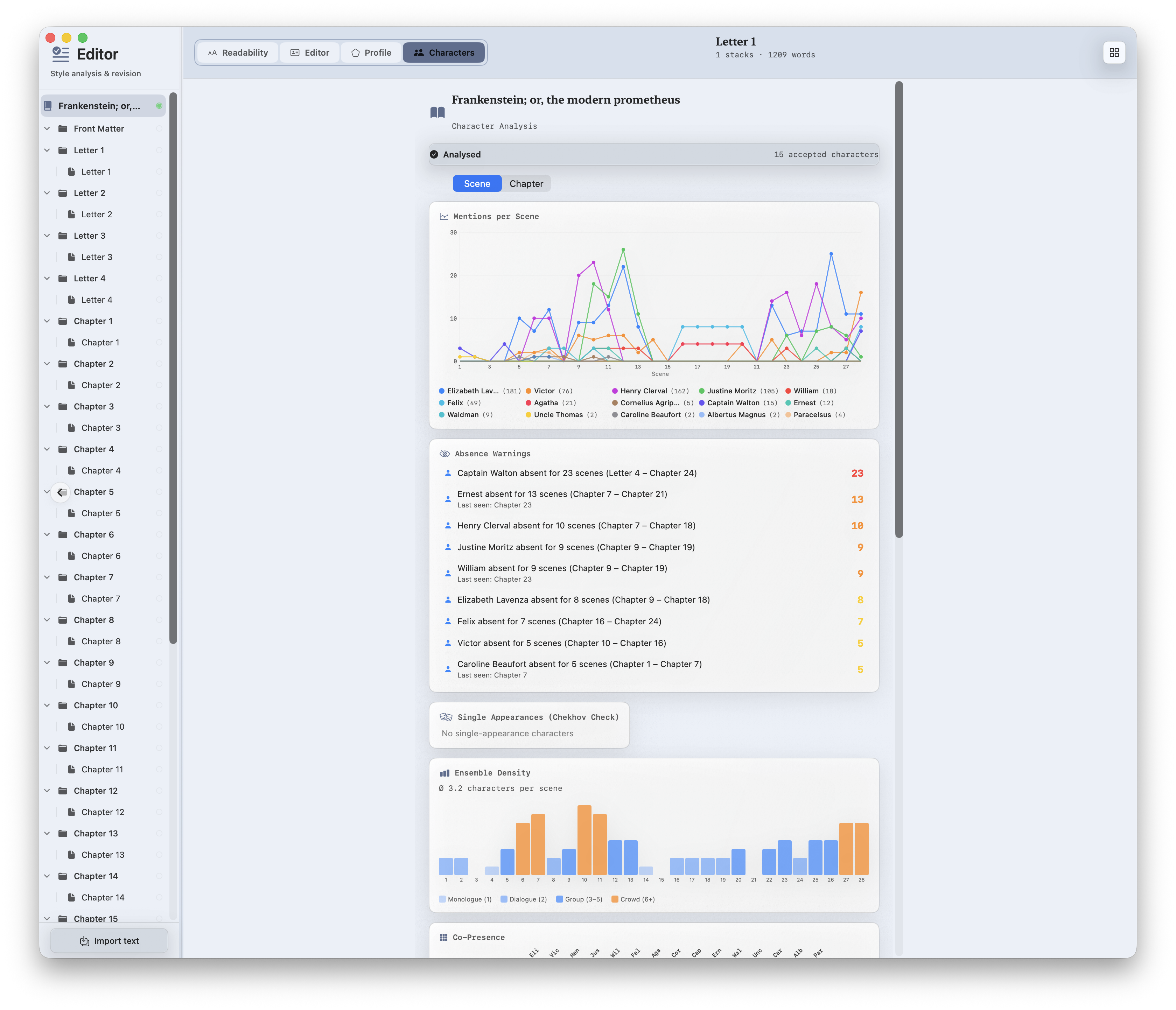
Tsukue's Entity Tracer identified 15 characters with enough scene presence to analyze. The high-confidence list resolved correctly: Elizabeth Lavenza, Henry Clerval, Victor, Justine Moritz, William, Felix, Agatha, Ernest, Waldman, Caroline Beaufort, and the three alchemist-scholars who haunt Victor's early obsessions -- Cornelius Agrippa, Albertus Magnus, and Paracelsus.
Captain Walton, the frame narrator, required a second import pass. The four opening letters didn't map cleanly to the chapter-based structure on the first attempt, and his scene count came out artificially low as a result. Once corrected, the mentions chart tells the right story: Elizabeth Lavenza leads with 181 mentions, Justine Moritz reaches 186, and Walton sits at 15 -- despite writing every word of the frame. He narrates the whole novel and barely registers as a character within it.
THE ABSENCE WARNINGS
The more structurally interesting output is what Tsukue calls Absence Warnings: characters who disappear from the narrative for extended stretches after their introduction. Frankenstein generates a long list.
Captain Walton: absent 23 scenes
Ernest: absent 13 scenes
Henry Clerval: absent 10 scenes
Justine Moritz: absent 9 scenes
William: absent 9 scenes
Elizabeth Lavenza: absent 8 scenes
Felix: absent 7 scenes
Victor: absent 5 scenes
Victor absent from his own novel for five scenes is worth pausing on. But the more structurally significant entry is Ernest, absent for 13 scenes. Ernest is Victor's younger brother, one of the people Victor is nominally trying to protect. He appears in only 4 scenes across 28 total. The person whose safety motivates half the plot is barely in it.
Henry Clerval, Victor's closest friend and the character most critics identify as his moral foil, disappears for 10 scenes between Letter 4 and Chapter 18. The creature manages more consistent narrative presence than Victor's best friend.
The people Victor claims to be acting for keep vanishing from the book. The creature never does. Whatever Frankenstein is actually about, it is not about the people Victor says it is about.
WHO NEVER MEETS
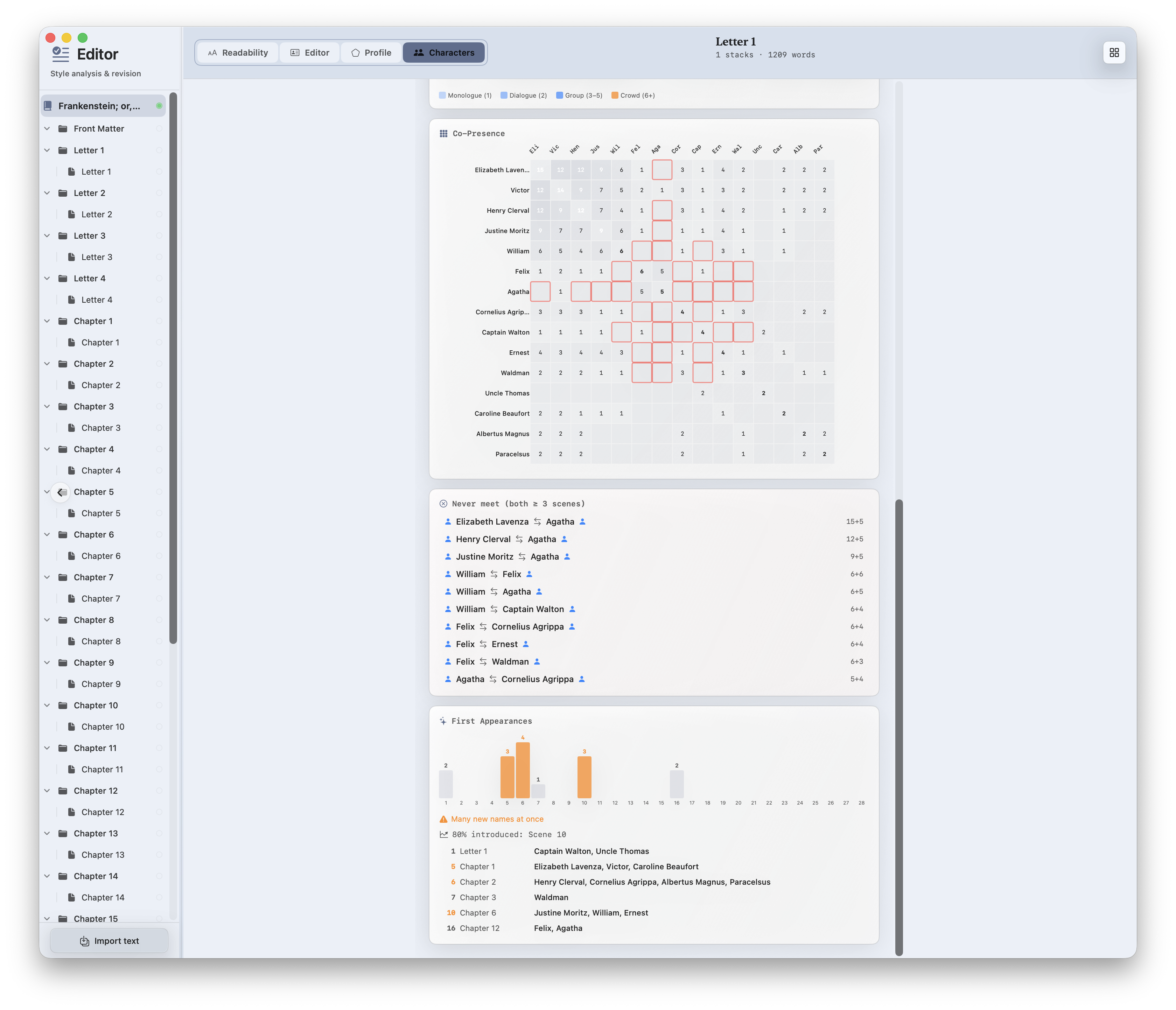
The most structurally revealing output is the co-presence matrix -- specifically the list of characters who are both significant and never appear in the same scene.
Elizabeth Lavenza and Agatha: 15 + 5 scenes, never shared
Henry Clerval and Agatha: 12 + 5 scenes, never shared
William and Captain Walton: 6 + 4 scenes, never shared
Felix and William: 6 + 6 scenes, never shared
Felix and Ernest: 6 + 4 scenes, never shared
Elizabeth Lavenza and Agatha never occupy the same scene. This is worth thinking about. Elizabeth is the moral center of Victor's domestic world -- the woman he is supposed to love, who grounds him in family and obligation. Agatha is the creature's surrogate for that same idea: the woman he watches through a wall for months, whose domestic warmth he cannot access. They are structural mirrors of each other, and they never meet. They couldn't: they exist in separate narrative layers. Elizabeth belongs to Victor's world. Agatha belongs to the creature's.
Shelley wrote a novel where the two women who represent the idea of home to the two protagonists are kept hermetically apart. The co-presence matrix did not discover this thesis. But it drew the diagram.
THE ENSEMBLE DENSITY
Frankenstein averages 3.2 characters per scene. The ensemble density chart shows a clear pattern: the novel oscillates between monologue and small-group scenes, with almost no true crowd sequences outside of a few mid-novel chapters. This is consistent with the nested-narrator structure -- most of the book is one person telling another person something. The creature's account of the De Lacey family is the only extended section that genuinely feels like an ensemble, and even that is observed through a wall.
---
Tsukue is a native macOS writing analysis app. One-time purchase, no subscription, no cloud. Currently in TestFlight: https://testflight.apple.com/join/8AFCuNbs