This text was used for analysis and explanation:
https://www.gutenberg.org/ebooks/64317
If you want to try it yourself - Tsukue is on TestFlight
https://testflight.apple.com/join/8AFCuNbs
The Tsukue Index Curve shows how readable your text is, paragraph by paragraph, across an entire manuscript. The y-axis runs from 0 to 100, higher means easier to read. The x-axis is simply your text in order, left to right, one data point per paragraph.
That's it. No mystery. But what *makes* the line go up or down? Let's walk through one of the most famous opening chapters in English literature and find out.
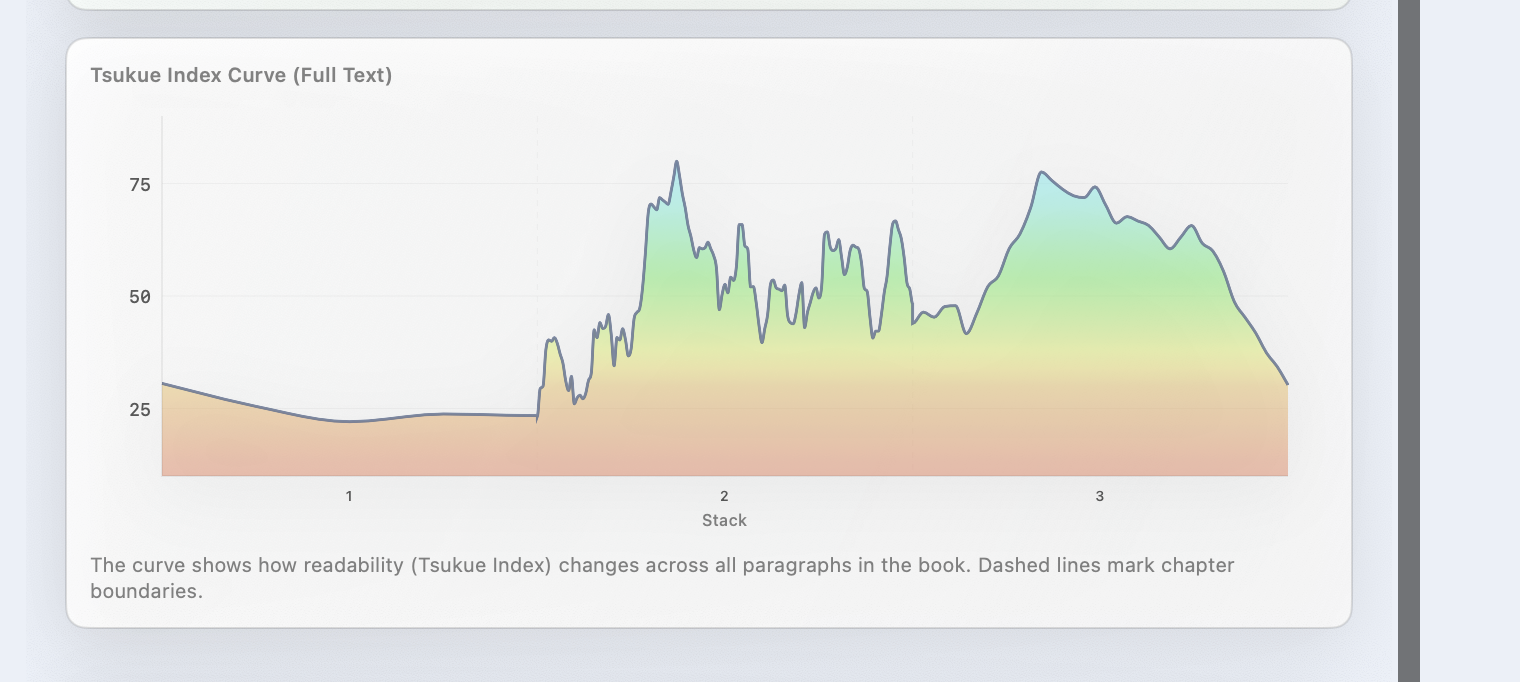
We split Chapter I of *The Great Gatsby* into three parts at Fitzgerald's own section breaks. In the curve, these show up as Stacks 1, 2, and 3.
Stack 1: The Philosophical Overture (Low and Flat)
What you see: The curve sits low, around 25, barely moving. It's the flattest, densest stretch of the entire chapter.
What's happening in the prose: Nick Carraway is philosophising. His father's advice. A meditation on tolerance, judgement, the nature of personality. Then a long, careful introduction of Gatsby, not as a character who does things, but as an idea wrapped in nested qualifications.
Why the curve is low: Look at what Fitzgerald is actually doing with the language here:
*"The abnormal mind is quick to detect and attach itself to this quality when it appears in a normal person, and so it came about that in college I was unjustly accused of being a politician, because I was privy to the secret griefs of wild, unknown men."*
That is one sentence. It contains a subordinate clause nested inside a subordinate clause, vocabulary like "plagiaristic" and "impressionability," and abstract nouns stacked on top of each other: "confidences," "revelation," "suppressions." Nothing here is concrete. Nothing is short. The sentences wind through multiple ideas before arriving at a period.
The Tsukue Index registers all of this: long sentences drive down readability. Abstract, infrequent vocabulary drives it down further. Deeply nested clause structures make the text harder to parse. The curve doesn't judge whether this is *good* writing. Fitzgerald clearly intended this density. It simply shows you: this passage demands a lot from the reader.
What a writer can learn: If your opening looks like this, you're asking for serious commitment before your reader has any reason to give it. Fitzgerald could afford that in 1925. You might not be able to. A flat, low line at the start of a manuscript is a warning flag, not because the writing is bad, but because the reader hasn't been hooked yet.
Stack 2: The World Opens Up (Volatile, Climbing)
What you see: The curve erupts. From that flat ~25 baseline, it suddenly jumps into the 40s, then 50s, then swings wildly between 50 and 80, with a dramatic spike near the beginning of the stack.
What's happening in the prose: Everything changes. Nick stops thinking and starts *doing*. He moves to West Egg. He describes his house, the weather, a neighbour asking for directions. Then we're at dinner with the Buchanans, and Fitzgerald fills the pages with dialogue.
The transition from Stack 1 to Stack 2 is one of the most dramatic readability shifts in the chapter, and the curve captures it precisely.
Why the curve climbs and swings: Three forces are at work here:
First: Concrete language replaces abstract language.
Nick is no longer talking about "the intimate revelations of young men", he's talking about a weather-beaten bungalow, an old Dodge, a Finnish woman muttering over a stove. The vocabulary drops from literary-philosophical to plainly physical. The Tsukue Index rewards this immediately.
Second: Sentences get shorter.
Compare the winding constructions of Stack 1 with this:
*"How do you get to West Egg village?" he asked helplessly. I told him.*
Two sentences. Seventeen words total. The curve spikes.
Third, and this is the big one: Dialogue.
Once Nick arrives at the Buchanan house, the text becomes roughly half dialogue. Dialogue is inherently readable: short turns, simple vocabulary, sentence fragments, direct verbs. Every time Daisy says "I'm p-paralysed with happiness" or Tom grunts "Who with?", the Tsukue Index registers a paragraph of extremely high readability, and the curve jumps up.
But then Nick inserts a passage of description or reflection between the dialogue lines, and the curve dips back down. This is what creates the *volatility*, that jagged, oscillating pattern you see across Stack 2. It's not noise. It's the rhythm of the scene: talk, describe, talk, reflect, talk.
The big spike near the start of Stack 2 corresponds to the stretch where Nick describes moving East in plain, autobiographical sentences and then the passage with the neighbour asking for directions, short, concrete, dialogue-driven. It's the most readable stretch so far, and the curve peaks accordingly.
The dips within Stack 2 correspond to the more literary descriptive passages: the extended metaphor of the two eggs of Long Island, the elaborate description of Tom Buchanan's body, the lyrical passage about Daisy's voice being "the kind of voice that the ear follows up and down." These are beautiful, but they're structurally complex, longer sentences, rarer words, more figurative language. The curve dips, then recovers when dialogue resumes.
What a writer can learn: Stack 2 shows what "pacing" actually looks like, measured. The oscillation between high (dialogue, action) and low (description, reflection) is what gives a chapter its rhythm. If your curve flatlines in the middle of a chapter, even at a *high* value, that can mean your scene is all talk with no texture. If it flatlines *low*, you may be over-describing. The volatility is the music.
Stack 3: The Evening Coda (High, Then Falling)
What you see: The curve starts high, among the highest points in the chapter, then gradually descends, with one more spike before falling off sharply at the very end.
What's happening in the prose: Jordan goes to bed. Tom and Daisy banter with Nick about a rumoured engagement. The dialogue is light, even playful. Then Nick drives home alone, and Fitzgerald shifts into the chapter's closing prose passage, the description of the night, the frogs, the moving cat, and finally Gatsby standing alone on his lawn, reaching toward the green light.
Why the curve behaves this way:
The opening of Stack 3 is almost pure dialogue, rapid, witty exchanges:
*"Good night, Mr. Carraway. See you anon."*
>
*"Of course you will," confirmed Daisy. "In fact I think I'll arrange a marriage."*
Short sentences, common words, conversational fragments. The curve sits high, in the 60s and 70s.
Then the dialogue thins out. Nick reflects on the evening, Daisy's insincerity, Tom's affair, the gossip about his own engagement. The sentences lengthen. The vocabulary becomes more introspective: "contributory emotion," "distinguished secret society." The curve starts sliding downward.
The final descent is the chapter's famous closing image. Fitzgerald leaves dialogue entirely and writes one of the most lyrical passages in the book:
*"…the silhouette of a moving cat wavered across the moonlight, and, turning my head to watch it, I saw that I was not alone - fifty feet away a figure had emerged from the shadow of my neighbour's mansion and was standing with his hands in his pockets regarding the silver pepper of the stars."*
Long sentences. Rare, evocative vocabulary ("silhouette," "wavered," "involuntarily"). Figurative language ("silver pepper of the stars"). No dialogue. The curve descends steadily, landing the chapter in a low, quiet register, exactly where Fitzgerald wanted it.
What a writer can learn: This is what a deliberate landing looks like in the curve. Fitzgerald doesn't end on a punchline or a cliffhanger, he ends on atmosphere. The descending curve is the shape of a chapter that *settles*. If your chapter ends with a sharp upward spike, you're ending on energy, which might be right for a thriller but wrong for a literary scene. The curve lets you see whether your ending matches your intention.
What the Curve Is (and Isn't)
The Tsukue Index Curve is not a quality meter. A low score doesn't mean bad writing. Fitzgerald's philosophical opening is magnificent, and it sits at 25.
What the curve *does* is make structure visible. It shows you:
- Where you're demanding effort from the reader (low regions)
- Where you're giving the reader a break (high regions)
- Where the rhythm changes (steep transitions)
- Where you might be monotonous (long flat stretches, high or low)
- Whether your ending matches your intent (rising = energy, falling = atmosphere)
A well-paced chapter typically has *shape*, it moves. A flat line at any altitude is worth questioning. And dramatic shifts between sections, like the jump from Stack 1 to Stack 2, should be intentional, not accidental.
The curve doesn't tell you what to write. It shows you what you *wrote*, from a distance far enough to see the shape of the whole.
How to Read the LDI Curve
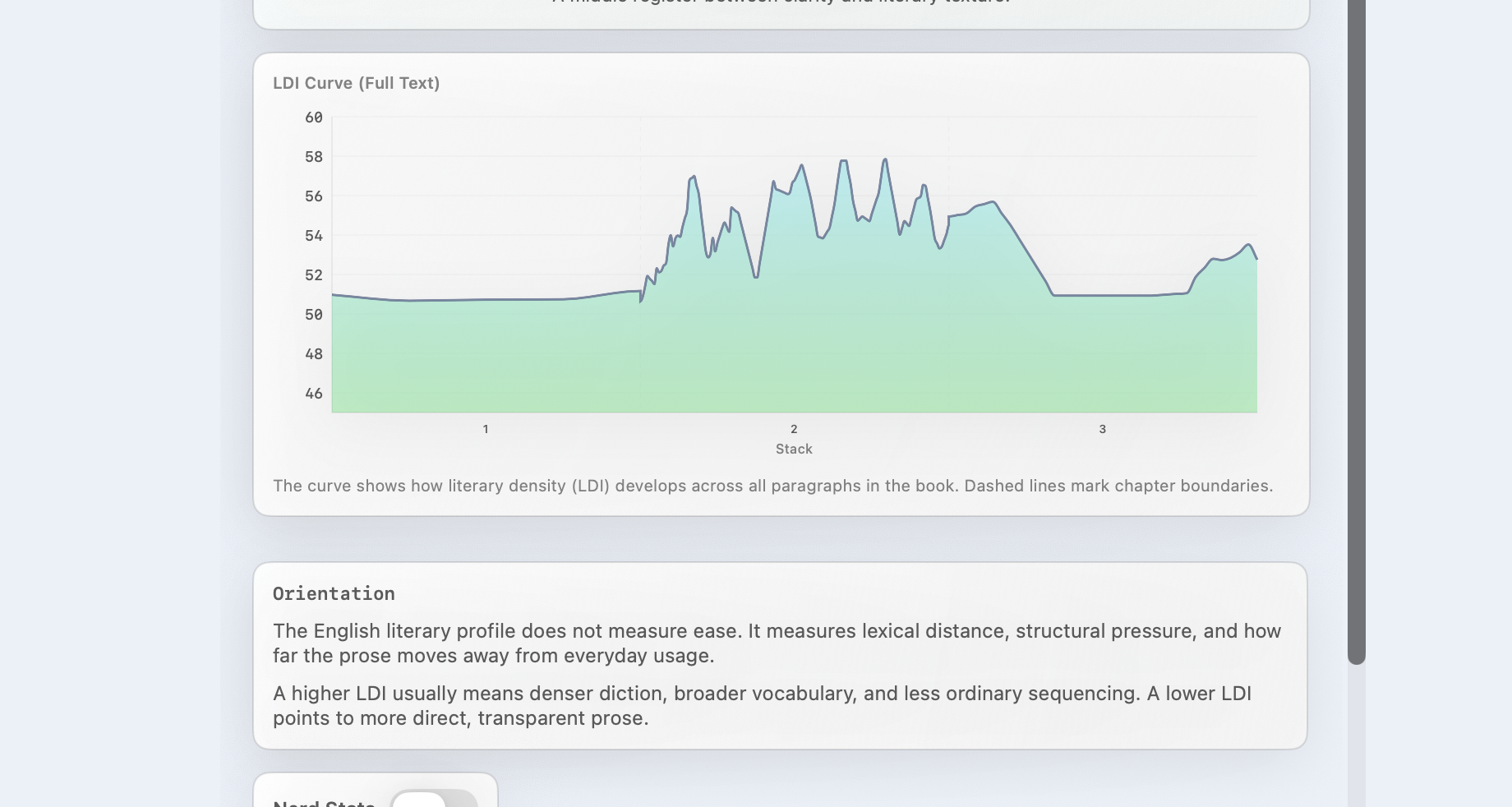
The same chapter, a different lens
The LDI (Literary Density Index) does not measure ease. It measures how far your prose moves away from everyday language: vocabulary richness, syntactic complexity, the "literariness" of the writing. A higher LDI means denser diction, broader vocabulary, and less predictable phrasing. A lower LDI means more direct, transparent prose.
Think of it as the *literary ambition* meter. The Tsukue Index asks "how easy is this to read?" The LDI asks "how much literary work is the writer doing here?"
The LDI responds to several dimensions at once: how varied your word choices are, how far your vocabulary reaches beyond the everyday, whether your sentence lengths are controlled or monotonous, and how predictable your phrasing patterns are. These dimensions are blended into a single score, so a high LDI means the prose is doing literary work on multiple fronts simultaneously.
The two curves have a similar shape across Chapter I of *The Great Gatsby*, but they measure different things, and the differences matter.
Stack 1: Steady and Elevated (~51)
What you see: The LDI sits just above 50 and barely moves. It's a flat, slightly elevated line, the most consistent stretch in the chapter.
Why: Nick's philosophical opening works at a consistent literary altitude. The vocabulary is sophisticated: words like "plagiaristic," "impressionability," "levity" reach well beyond common usage. The phrasing is unpredictable; Fitzgerald doesn't fall into stock phrases here. And each paragraph introduces new abstract concepts rather than circling back over the same terms.
But the LDI doesn't *spike* because Fitzgerald's sentences in this section are consistently long, often 40+ words. The LDI doesn't simply reward length; it recognises that endlessly winding constructions can become their own kind of monotony. So the sophisticated vocabulary pushes the score up, while the uniform sentence structure holds it back. The result is a steady, elevated line, ambitious prose running at a controlled altitude.
Compare this to the Tsukue Index: The readability curve was also flat here, but *low*, around 25. The LDI is flat but *above centre*. Both curves agree: this section is uniformly demanding. But the LDI adds a nuance: the prose isn't just hard to read, it's doing sustained literary work: rich vocabulary, unpredictable phrasing, held in check only by its own sentence length.
Stack 2: Peaks and Valleys (51–58)
What you see: The LDI erupts into the chapter's most volatile stretch. Sharp spikes up to 57–58, sudden dips back toward 51, constant movement.
Why: This is where Fitzgerald alternates between two very different registers.
When dialogue dominates, Tom's blunt questions, Daisy's breezy chatter, the short exchanges at dinner, the LDI drops. Dialogue uses common words, familiar phrasing patterns, and a limited vocabulary pool within each exchange. It's linguistically *transparent*.
But between the dialogue lines, Fitzgerald inserts passages of extraordinary literary density: the description of the two eggs of Long Island, Tom Buchanan's body, the curtains blowing through the room, Daisy's voice. These passages are doing literary work on every dimension at once. The vocabulary is rich and varied. The word combinations are surprising: "frosted wedding-cake of the ceiling," "wine-coloured rug." And the sentence lengths are more controlled than in Stack 1: complex but disciplined, not endlessly winding.
The biggest spikes are where everything aligns at once. That's the LDI's signature of genuinely literary prose, not just fancy words, but varied vocabulary *and* unpredictable phrasing *and* controlled sentence structure working together.
Stack 3: High Plateau, Then Descent
What you see: The curve settles into an elevated range around 53–55, less volatile than Stack 2, then drops at the very end before a small final uptick.
Why: The dialogue in Stack 3 is lighter and quicker, playful banter about Jordan, the engagement rumour, Daisy's teasing. But Nick's narration between the lines stays literary, keeping the LDI from dropping as far as the dialogue-heavy dips in Stack 2. The overall effect is a smoother, higher plateau.
The final descent is revealing. As Nick drives home and Fitzgerald moves into the closing imagery, the frogs, the cat, Gatsby on the lawn, you might expect the LDI to spike. It's some of the most celebrated writing in the book. But the vocabulary is deliberately plain: "wind," "night," "trees," "moonlight," "stars." The sentences are long and flowing. The literary effect of this passage comes from rhythm, image, and atmosphere, qualities that live in the *arrangement* of common words rather than in the words themselves.
The LDI dips because it measures the raw material of the prose, the words and their patterns. When Fitzgerald builds beauty out of simple ingredients, the metric is honest about what it sees and what it can't. The magic here is in the architecture, not the bricks.
Reading the Two Curves Together
The Tsukue Index and the LDI are most useful side by side. When the Tsukue Index is high and the LDI is low, your prose is clear and direct, easy to read without much literary complexity: pure dialogue, plain narration, giving the reader a rest. When both are high, you're in rare territory: linguistically dense *and* still readable, which usually means strong literary control. When the Tsukue Index is low and the LDI is high, you're writing ambitious prose that may be demanding too much. And when both are low, the text is neither easy to read nor literarily rich, which can signal flat, laboured prose that needs reworking.
Fitzgerald's Chapter I uses all four modes. That's part of why it works.